The Silent Destroyer: Why Is Tobacco "Killing" Your Periodontal Tissue from Within?
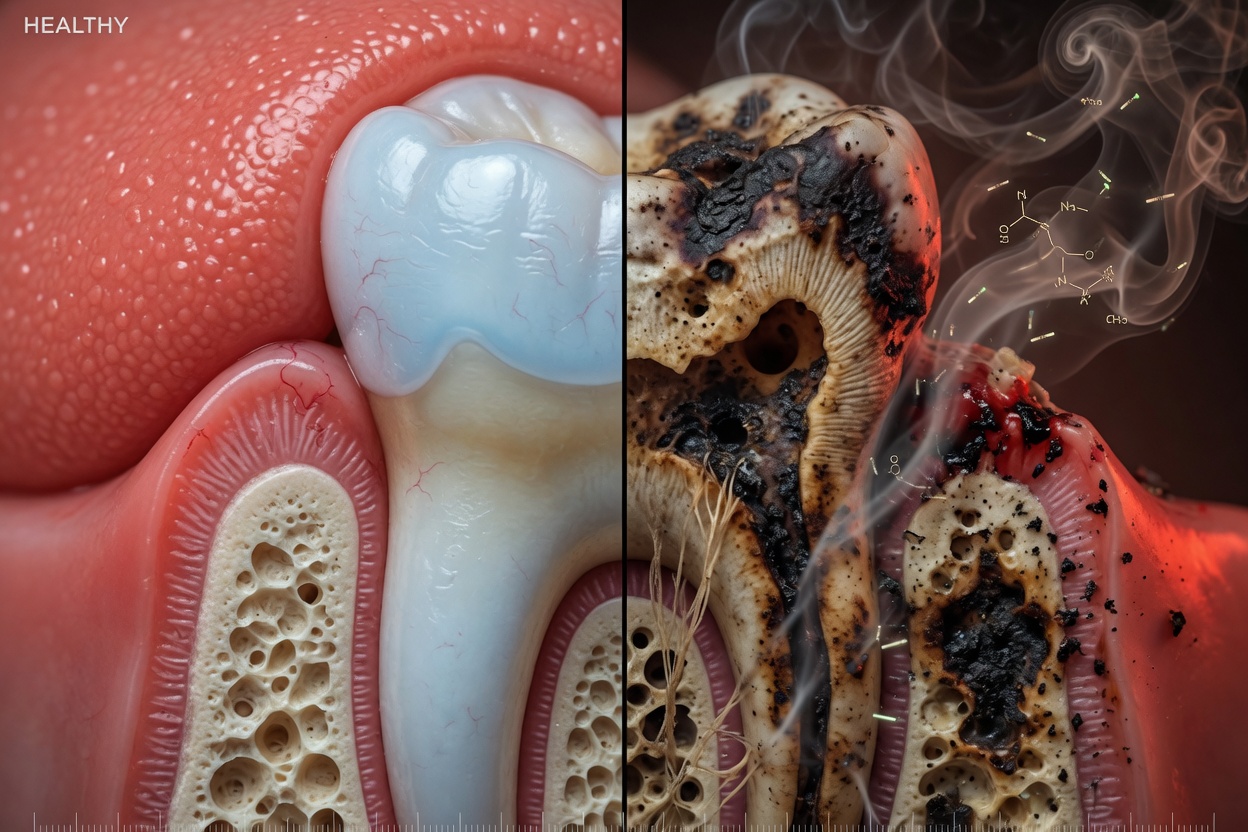
When you look in the mirror and see your gums showing a seemingly healthy pale pink color, with almost no bleeding even when brushing, you might think your oral health is good. But for a long-term smoker, this can be an extremely dangerous illusion.
In clinical practice, I often encounter such patients. They often only realize the severity of the problem when their teeth have become noticeably loose or even need extraction. They often say: "Doctor, my gums never bleed, how could I have periodontal disease?"
This is the most insidious aspect of tobacco — it not only destroys your periodontium but also, in an extremely concealed way, masks the distress signals sent by your body.
The "Gallows" of Blood Vessels: Masked Distress Signals
To understand how smoking destroys the periodontium, we must first talk about blood vessels.
Periodontal tissue (including gums, periodontal ligament, and alveolar bone) is a system highly dependent on blood supply. Blood not only provides oxygen and nutrients to these tissues but also undertakes the critical tasks of transporting immune cells and clearing metabolic waste. Nicotine, the core addictive substance in tobacco, is an extremely powerful **vasoconstrictor**.
When you inhale tobacco, nicotine rapidly enters the bloodstream, stimulates adrenaline release, and causes intense constriction of gingival microvessels. This long-term vasoconstriction leads to chronic hypoxia (Hypoxia) in periodontal tissue. Imagine if a city's water supply system were kept half-closed for a long time — the city's cleaning work and building maintenance would become extremely difficult.
More frighteningly, this vasoconstriction produces a "camouflage effect." In normal periodontal inflammation, gum congestion, swelling, and bleeding are natural reactions of the body trying to recruit immune cells by increasing local blood flow. However, the persistent vasoconstriction brought by tobacco forcibly suppresses this inflammatory response. The result: even when your periodontium is undergoing severe tissue destruction and bone resorption, your gums may still appear "healthy" and barely bleed. This clinical "false health" causes many patients to miss the optimal treatment window.
Microbial "Breeding Ground": The Collapse of Oral Ecology
Beyond the physical blood supply issue, tobacco also artificially creates a "breeding ground" conducive to the growth of pathogens by altering the chemical environment of the mouth.
A healthy oral cavity is a precise microbial ecosystem (Microbiome), containing abundant probiotics and commensal bacteria that maintain oral homeostasis. However, smoking completely disrupts this balance.
Research shows that smoking significantly reduces the biodiversity of oral microbes. The oral environment of long-term smokers often exhibits pathological characteristics: the abundance of harmful bacteria (such as the periodontal pathogen *Porphyromonas gingivalis*) significantly increases, while health-maintaining flora (such as *Neisseria* or *Rothia*) are greatly reduced.
Why can tobacco achieve this? First, the chemical substances in tobacco smoke alter the oxygen partial pressure and pH value within the mouth, creating an environment more suitable for anaerobic pathogen growth. Second, tobacco components can enhance the virulence of certain pathogens, making it easier for them to form difficult-to-remove biofilms in periodontal pockets. This is like artificially introducing a large number of invasive species into a balanced forest and laying out special nutrients for them, ultimately leading to the collapse of the entire ecosystem.
The "Silent War" at the Molecular Level: Inflammation and Immune Dysregulation
When pathogens gain the upper hand and the body's defense systems are weakened, a "silent war" at the molecular level begins.
In a normal immune response, when bacteria invade, immune cells release cytokines (such as IL-1β, IL-6, TNF-α) to recruit reinforcements. But in the oral cavity of a smoker, this immune response becomes both chaotic and inefficient.
Nicotine and other toxins in tobacco induce **Oxidative Stress**, generating large amounts of reactive oxygen species (ROS). These free radicals directly attack the DNA and proteins of periodontal cells, causing cellular damage. Simultaneously, smoking activates a complex protein complex called **NLRP3 inflammasome**, leading to a chronic, persistent low-level inflammation.
This inflammation is not the "red, swollen, hot, painful" acute type but a chronic, persistent tissue destruction. It continuously stimulates the activity of osteoclasts, causing alveolar bone to be gradually resorbed and lost. By the time you feel your teeth starting to loosen, the bone supporting them may have long been consumed by the synergistic action of these molecules.
The Fatal Blow: "Castrated" Self-Repair Ability
If the above processes are still destroying tissue, the most deadly point is this: smoking deprives your body of its ability to "self-repair."
The regeneration of periodontal tissue highly depends on **Periodontal Ligament Stem Cells (PDLSCs)**. These stem cells are like "construction workers" in the body, responsible for differentiating and rebuilding the periodontal ligament and alveolar bone when tissue is damaged.
However, the latest research (2025 research advances) reveals a shocking fact: nicotine directly "castrates" the function of these stem cells. It interferes with key signaling pathways such as **Wnt/β-catenin** and **BMP/Smad**, inhibiting stem cell proliferation and osteogenic differentiation.
This means that even if you remove bacteria through cleaning or surgery, due to the stem cells' "strike," your periodontal tissue struggles to achieve high-quality regeneration. In smokers' periodontal tissue, the healing process is often inefficient and incomplete, further exacerbating the recurrence and deterioration of periodontal disease.
Clinical Case: A Patient Deceived by "Illusion"
Let's look at a real clinical observation.
Patient Mr. Li, 52 years old, with a 30-year history of heavy smoking. During his initial visit, he had no subjective symptoms of tooth pain or gum bleeding. However, clinical probing revealed that multiple periodontal pockets had reached a depth of 6-7mm, accompanied by noticeable tooth mobility.
Through X-ray observation, I found that his alveolar bone resorption had already reached one-third of the root length. Surprisingly, his gums appeared very firm externally, without even noticeable redness or swelling.
Mr. Li was very confused: "Doctor, I brush my teeth carefully every day, and my gums don't bleed. Why has so much bone been lost?"
I told him: "Mr. Li, your gums don't bleed not because you are healthy, but because nicotine has 'locked' your blood vessels. Your body is sending distress signals, but those signals are being intercepted by tobacco."
This phenomenon is not rare in clinical practice. Smokers are often diagnosed only when the disease has reached the middle or late stages, by which time irreversible bone resorption and tooth loosening have already occurred.
Visual Warning: The "Brand" Left by Tobacco
Beyond the invisible internal destruction, tobacco also leaves noticeable visual warnings.
A phenomenon called **Smoker's Melanosis** is a direct effect of tobacco on the oral mucosa. Due to chemical irritants in tobacco inducing hyperactivity of melanocytes, smokers often develop brown-black or black pigmentation on their gums, palate, and other areas. Although benign, it is the body telling you: chemical substances are eroding your tissues.
Additionally, tar in tobacco forms stubborn, deep brown pigment deposits on tooth surfaces that are difficult to remove through regular brushing. These deposits not only affect aesthetics but also act like a thick "protective shield," providing more stable attachment points for bacteria.
How Can You Save Yourself?
Faced with such a complex destruction mechanism, are we simply helpless? Of course not.
First, **the most important and most effective measure is: quit smoking**.
Once you stop smoking, your oral microenvironment will begin a miraculous transformation. Vascular function will gradually recover, inflammation levels will drop, and the oral microbiota will strive to return to a healthy balance. Although bone resorption that has already occurred cannot be fully reversed, quitting smoking can significantly improve the effectiveness of periodontal treatment and greatly reduce the risk of disease recurrence.
Second, **do not be fooled by the "lack of bleeding"**.
If you have a smoking history, even if your gums look healthy, you should undergo regular professional periodontal examinations. The "probing depth" measured by a doctor's probe and the "bone level" observed on X-rays are the real standards for measuring your periodontal health.
Conclusion
Smoking's destruction of the periodontium is a comprehensive, multi-dimensional systemic attack — from blood vessels, microbes, and molecules to stem cells. It is not only dismantling your oral defenses but also cutting off your logistical supplies and disabling your repair team.
Do not wait until the day your teeth loosen to regret it. Put down your cigarette now and give your periodontal tissue a chance to regenerate.
*This article is based on the latest oral medical research (including 2024-2025 research advances) and aims to provide professional health information. If you have periodontal issues, please consult a professional dentist.*